
Baseload
“When I use a word,’ Humpty Dumpty said in rather a scornful tone, ‘it means just what I choose it to mean — neither more nor less.’ (in Lewis Carroll's Through the Looking Glass )

Our first step when encountering a word is to understand what it means. Consulting Wikipedia, we find:
The base load (also baseload) is the minimum level of demand on an electrical grid over a span of time, for example, one week.
In Energy Education,
Baseload power refers to the minimum amount of electric power needed to be supplied to the electrical grid at any given time
Here we find a nice explanation (comparing base load to peak load) and a useful graphic:
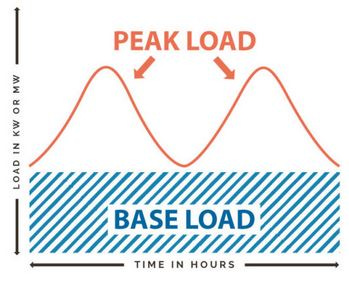
Finally, here we find
The minimum amount of electricity required by an electrical grid to meet the continuous demand for power over a period of 24 hours.
While there is mostly agreement, there may be some doubt as to whether baseload is a characteristic of supply or of demand. Secondly what period of measurement should be used? Instantaneous? A day? A week? An arbitrary period of time? So, allow me to pull a Humpty Dumpty:
Baseload is the minimum demand in a year-to-date (YTD)
I like this definition because baseload cares not how or why or even if there is supply, only that there is a lower bound to a need. I like the period I’ve selected because it includes all seasons (think of places with very cold winters and electric heating or places with very hot summers and heavy demand from air-conditioning) and it allows for evolution. If demand is trending upwards then today’s measurement will be the best available historic measurement.
I’ve carefully avoided specifying what baseload is measured on - the term could be used to characterize a house or an office block - but I want to apply the terms to an electricity system, for example the South African grid. That’s all the consumers of electricity in South Africa (houses, office blocks, street lights, traffic lights and even sources of electricity - when being charged - like batteries and pumped hydro storage).
I understand that yesterday’s minimum demand may differ from the minimum demand the previous day - so I’m sympathetic to the “over a period of 24 hours” definition - but I want a definition which effectively says, no matter what, this is the least amount of electricity which must be supplied at all times.
That was easy, so what’s the problem?
The problem is that we are bombarded with headlines such as Nick Hedley’s
“The 'baseload' energy argument is redundant”
or Giles Parkinson’s
“‘Baseload’: An outdated term that should not be confused with ‘reliability’”
or Dirk de Vos’
“Time to Kick the Baseload Addiction”
The latter two references almost immediately substitute the word “baseload” with the phrase “baseload power”, that is they change the topic from demand to supply (and the first author does it in the article’s title, referring to ‘baseload energy’, with a sneer at ‘baseload’).
This is a classic example of a “bait and switch”. These authors make no secret of their preferences, preferences which are hurt by the fact that nobody would argue that PV panels are “baseload power” when baseload tends to be defined by demand at night. Just so, nobody would argue that wind turbines are “baseload power” on a calm, a windless night.
How is baseload supplied? It is entirely possible that there are sub-periods in the baseload period when minimum demand (baseload) was supplied entirely from one source and other sub-periods when minimum demand is met by a mix of sources. The word baseload has a sensible meaning; it’s about demand. The phrase “baseload power” or “baseload energy” are about supply. A debate about how minimum demand is to be met does not have to be strengthened by attacking a sensible definition of a term for that minimum demand.
Posts like this in X (formerly Twitter) abound.
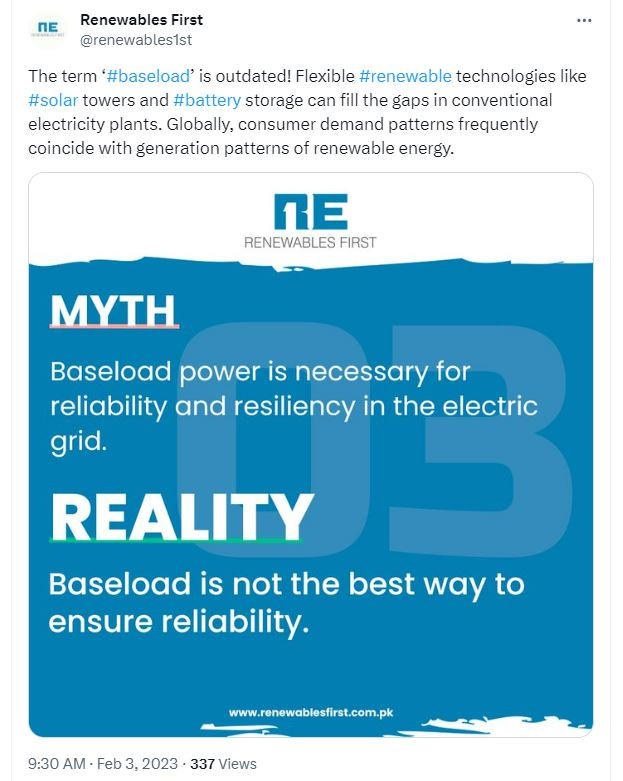
No, the term “baseload” is not “outdated” and the “Reality” can be tested by substituting “Baseload” with it’s meaning, “Minimum demand in a period”, or even simpler, merely one word, “demand”.
“Demand is not the best way to ensure reliability”.
Really?!
Words are important. Use them responsibly!